How to improve desk lighting and reduce glare
Use the window and your working hours as the starting point.
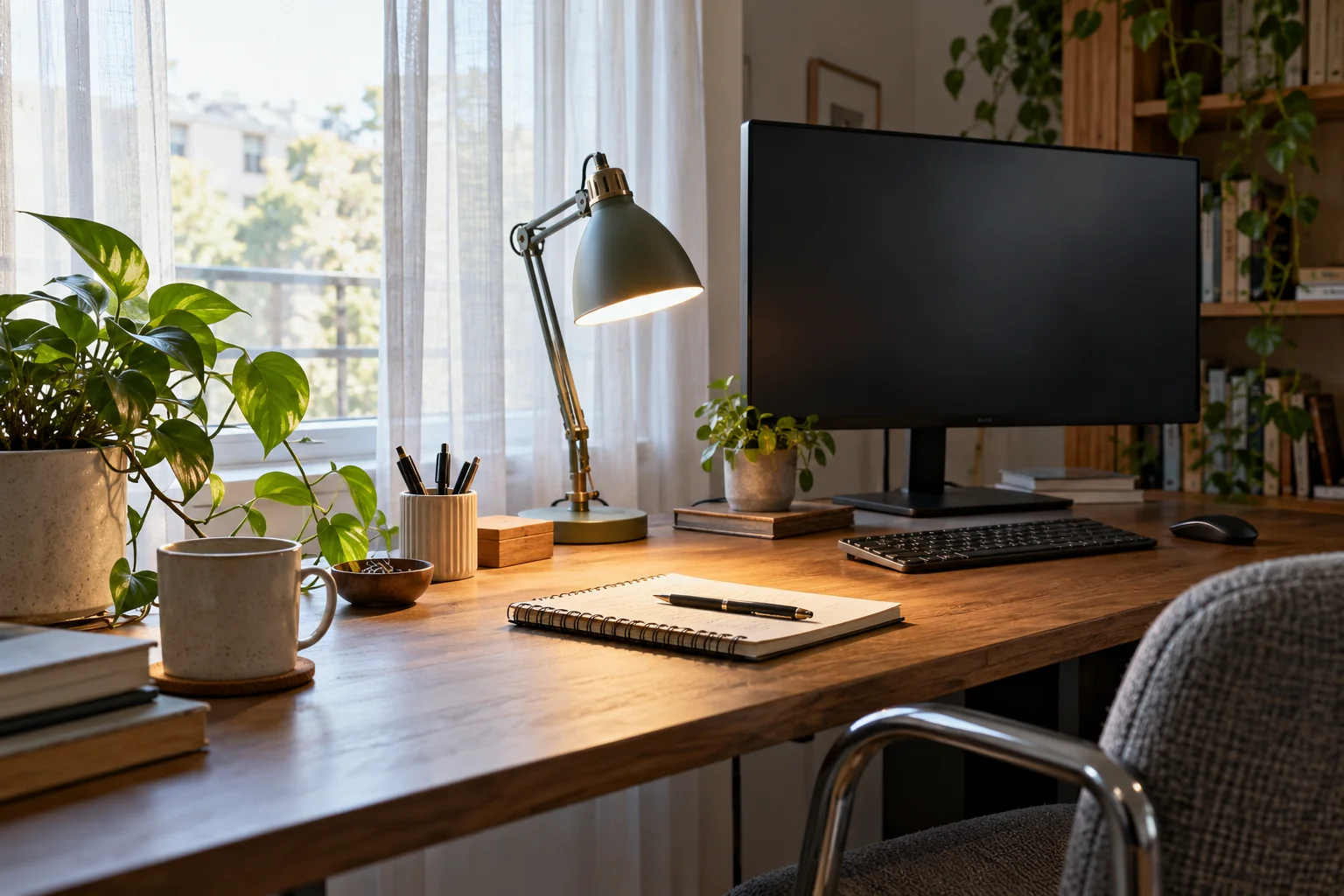
An office can feel pleasantly bright while its screen remains difficult to read. The problem might be a reflection, a bright window in your field of view, or a lamp pointed at the wrong surface. Before buying a stronger light, observe the room when you actually work. A few changes to the desk direction, window covering, or task lamp can be more useful than increasing brightness everywhere.
Find the source of the reflection
Look at a dark screen from your normal seated position and note the shapes reflected in it. Repeat this in the morning, around midday, and during an evening work session. A problem that appears only at one hour often comes from the sun rather than the ceiling light. OSHA suggests positioning screens to reduce reflections from windows and light sources. Try rotating the arrangement so the window is to the side, then check again while reading a real document. Keep a brief photo record so you can compare changes under similar conditions.
Light the task that needs it
Decide whether the additional light is for reading paper, writing, craft work, or simply making the room comfortable after dark. Place a movable lamp where your hand and screen do not block the useful light, and check its position from the chair rather than only from the doorway. A broad pool over the notebook may be enough; the entire desktop does not need to become a spotlight. Test with the usual room lighting on. If a lamp helps the paper but introduces a new screen reflection, change its angle or location before replacing the bulb.
Build a repeatable evening setting
Make a simple evening arrangement you can restore without experimenting every night: a chosen blind position, one task lamp angle, and an appropriate room light setting. Check the view on video calls separately, because lighting your face and lighting a notebook are different jobs. Keep controls easy to reach and choose fittings compatible with the bulbs or dimmers specified by their manufacturers. Record which adjustment solved which problem. This lets you make a targeted purchase later instead of buying several lights and hoping that one happens to suit the room.
Before you begin
- Check reflections at normal working hours.
- Try the window beside the screen.
- Test a lamp with real paper tasks.
- Review the camera view separately.
- Save the useful lamp and blind positions.
Treat glare as a positioning problem before treating it as a shopping problem. Once you know where the unwanted light comes from, you can select a window covering or task light for a specific purpose.
Plan your project with Remendia